
Home

Our research interest is directed towards the multidimensional description and understanding of biological systems. We develop microfluidics-based biosystems to catch and reproduce biological features: hierarchical organization, function and dynamics. This is based on expertise in biopolymers self-assembly, biomaterials engineering and nano/microfabrication for biosystems engineering.
News and highlights


Check out our latest article on collagen chemical physics in biomaterials just accepted in Biomacromolecules / July 2024: Krins, N. et al. Angle-resolved linear dichroism to probe the organization of highly-ordered collagen biomaterials. ChemRxiv, https://chemrxiv.org/engage/chemrxiv/article-details/66589ee4418a5379b0ad7718.
Check out our new preprint on the design of advanced biomolecular tools to check integrins dynamics in cancer cells: Kamboj, S. et al. Hotwiring integrin endocytosis acutely modulates cell interactions. BioRxiv, https://www.biorxiv.org/content/10.1101/2024.06.24.600360v1
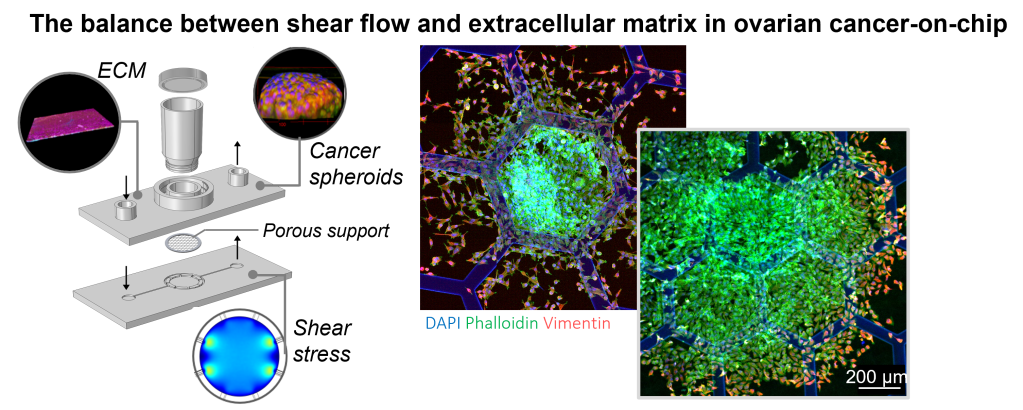
ECM models based on ECM proteins are integrated in microfluidic chips to uncouple the impact of ECM and shear stress in ovarian cancer migration. In the shear stress regime of the peritoneal cavity, the ECM prevails over shear stress. In presence of basement membrane proteins, migration is more collective that on type I collagen regardless of shear stress.


Léna VILLERABEL & Maxime MAUVIEL joined the group to work on the Perfusion of 3D Printed collagen hydrogels to model the Extracellular matrix of Robust and Fibrotic skeletal muscle in collaboration with Christophe Hélary @ Sorbonne University.




 Carole Aimé